The Spanish capital has long been a center for culture and politics, but in the last few years, Madrid has transformed into a global economic and tourism juggernaut. If you’ve walked through the soaring, wave-like terminal of Adolfo Suárez Madrid-Barajas Airport recently, you’ve likely felt the shift. It isn’t just busy; it is vibrating with a new kind of energy.
To understand the trajectory of Madrid, we must look at the data—the “Real Stats”—that define the pre-pandemic peak, the massive recovery of 2024, and the ambitious projections for 2025.
The 2019 Benchmark: A Record Broken
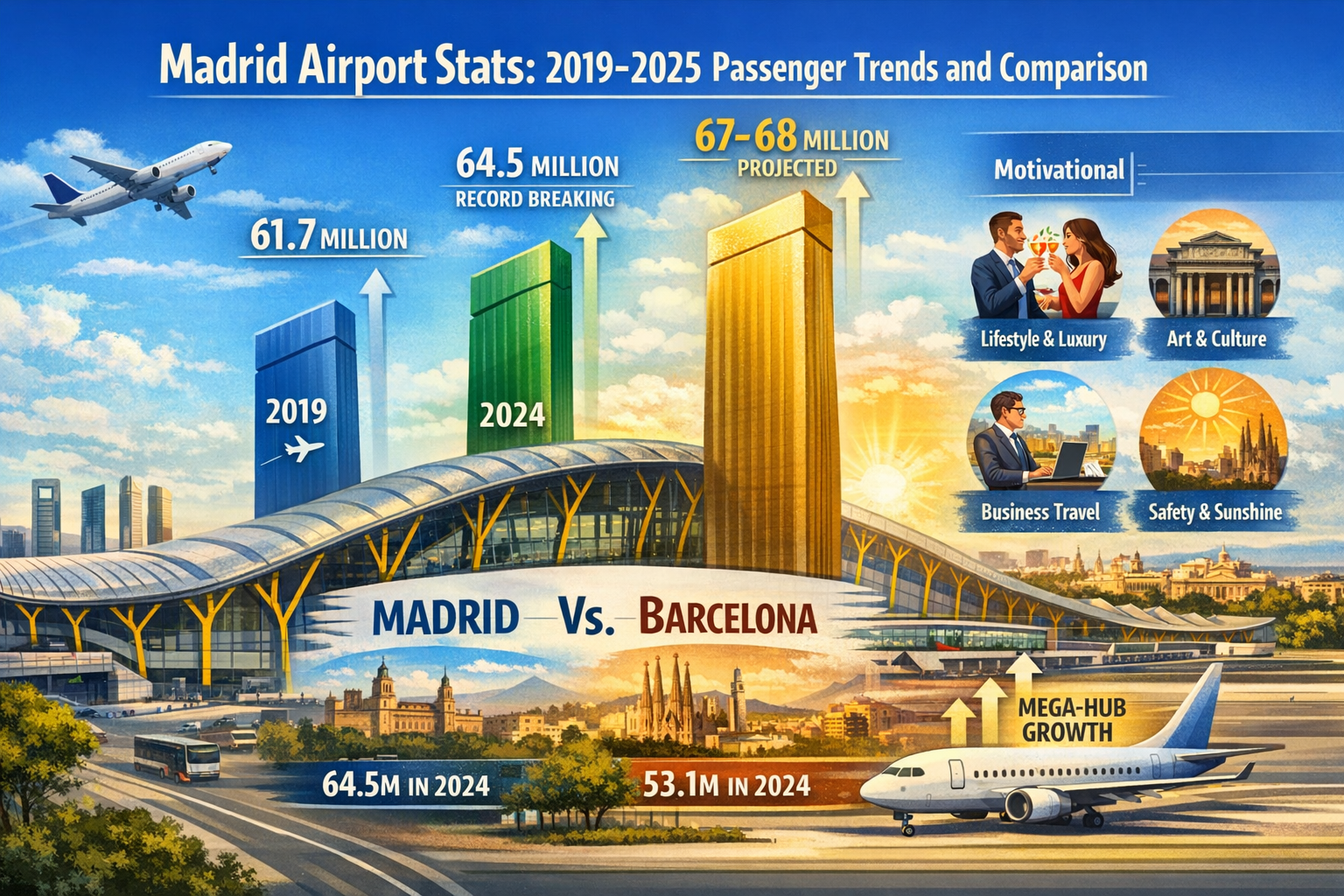
Before the world changed in 2020, Madrid-Barajas was riding a historic high. In 2019, the airport handled 61.7 million passengers. At that time, it was the fifth-busiest airport in Europe. Madrid was the undisputed king of the Ibero-American connection, acting as the primary bridge between Europe and Latin America.
2024: The Year of Total Recovery
If 2023 was about getting back to “normal,” 2024 was about setting a new “gold standard.” According to official data from Aena (the Spanish airport authority), Madrid-Barajas saw a massive surge in 2024.
By the end of 2024, Madrid handled approximately 64.5 million passengers. This isn’t just a recovery; it’s a 4.5% increase over its greatest historical peak in 2019. The trend is clear: people are not “going elsewhere.” They are choosing Madrid more than ever before.
Navigating the Capital: Getting to the Center
With over 60 million people passing through the gates, the logistical challenge of reaching the city center has increased. While the Metro and Cercanías trains are available, the sheer volume of travelers has led to a spike in demand for pre-booked transport. For those arriving with luggage or in groups, you can find information on private airport transfers and how to get from Madrid Airport to the city center here.
2025 Projections: Chasing the 70 Million Mark
As we look at the data for 2025, the growth shows no signs of stagnating. Early indicators and airline seat allocations suggest that Madrid will push toward 67–68 million passengers by the end of 2025.
The investment in the “Master Plan” for Barajas is the reason. Spain is betting big on Madrid becoming a “Mega-Hub” to rival London Heathrow and Paris CDG. The trend for 2025 is the expansion of the “Executive Traveler” and the “Luxury Tourist”—Madrid is no longer just a transit point; it is the destination.
Madrid vs. Barcelona: The Spanish Rivalry
The question often arises: Is Madrid growing at the expense of Barcelona, or is all of Spain rising together?
- Madrid (MAD): Madrid is the larger hub and has seen a more robust recovery in the long-haul sector. Its growth is fueled by being the business heart of the country and its massive connection to the Americas.
- Barcelona (BCN): Barcelona-El Prat also saw a record-breaking 2024, handling 53.1 million passengers. However, while Madrid has surpassed its 2019 levels by a comfortable margin, Barcelona only recently edged past its 2019 peak (which was 52.6 million).
The Comparison: Both cities are moving in the same upward direction, but Madrid is growing at a faster tempo. While Barcelona’s growth is heavily tied to European low-cost tourism and Mediterranean cruises, Madrid is diversifying faster into international business and high-end intercontinental travel.
If your travels take you to the Catalan capital instead, you can find similar information on Barcelona Airport transfers here.
Why are people coming to Madrid? The Main Motivations
Why is Madrid winning the “speed race” for growth? The motivations for travelers in 2024 and 2025 have shifted significantly:
1. The “Lifestyle” Migration
Madrid has become the “Miami of Europe.” A massive influx of Latin American investment and residents has turned the city into a vibrant, high-end lifestyle hub. This creates a “dopamine effect” of new restaurants, luxury boutiques, and world-class hotels (like the Four Seasons and Mandarin Oriental) that keep travelers coming back.
2. The Cultural Powerhouse
While Barcelona has the beach, Madrid has the “Golden Triangle of Art.” The Prado, Reina Sofía, and Thyssen-Bornemisza museums are seeing record ticket sales. Additionally, Madrid has become the European capital of musical theater, attracting Spanish speakers from all over the world.
3. Business and “Workations”
Madrid’s infrastructure is perfectly suited for the modern “bleisure” traveler—those who combine business with leisure. With lightning-fast 5G, endless coworking spaces, and a top-tier culinary scene for networking, the business motivation is a primary driver of the mid-week flight stats.
4. Safety and Sunlight
In a world of increasing travel uncertainty, Madrid is perceived as one of the safest major capitals in Europe. Combined with over 300 days of sunshine a year, it is the ultimate “reliable” vacation.
Real Stats: The Evidence
The data used in this report is pulled directly from the official regulatory bodies. You can verify these numbers and explore deeper aviation trends at the following links:
- Source: Aena Traffic Reports (Official Spanish Airport Stats)
- Source: INE (National Statistics Institute of Spain) – Tourism Data
Final Verdict: Is Madrid Growing?
The numbers don’t lie. Madrid is not just growing; it is outperforming almost every other major European hub in terms of post-pandemic resilience. The city has successfully rebranded itself from a political capital into a global “must-visit” cultural and luxury destination.
Whether you are flying in for a meeting in the Cuatro Torres Business Area or a night of tapas in La Latina, the trend is clear: Madrid is the place to be in 2025.


